Rediscovering the Portrayals of Aging in Albania’s 1980s Cinema
How 1980s films, now preserved and digitized, have become a resource for researchers and curious viewers alike.
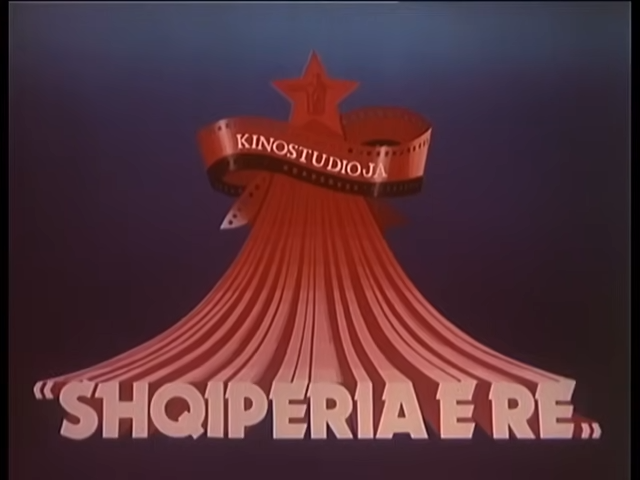
One of the two film opening logos Kinostudio Shqipëria e re/The New Albania Film Studio used in the 1980s
Courtesy of the Albanian Central Film Archive (AQShF)
On two neighboring balconies in a Tirana apartment building, a group of retirees share coffee and conversation. Their topic is the state-run retirement home. One of the men already lives there, but he has come to visit his friend Tase, who has no family and lives alone. Tase admits he is considering the institution, though he dislikes its rules. “I’m a horse without reins,” he declares to Kalina, the widowed neighbor next door. Kalina is firm in her opinion of institutional care: “I would never bring such shame to my family,” she says.
This exchange comes from Albert Xholi’s 1987 comedy Familja ime (My Family), which follows Kalina’s story. After the death of her husband, and being childless, she moves in with her nephew’s family in the city, unable to live alone. Her arrival unsettles the household. Kalina takes over the kitchen, insists on managing the cleaning and even meddles in trying to arrange a marriage for the family’s daughter. These actions provoke tension with her nephew and his wife. Yet the film has a tender arc. Kalina’s stubborn presence ultimately becomes a source of love and unity, and she is embraced as the heart of the family.
It’s a typically formulaic communist-era Albanian film, but it does tell us about the discussions on institutional elder care at the time. Extended families are expected to take in older adults. Institutional homes are only for those completely alone.
Having recently done a deep dive into the Albanian cinema of the 1980s, I rediscovered several films like Familja Ime and a wealth of information on the demographic discourse of the time. It offered a window, albeit skewed by propaganda, on what aging was like in 1980s Albania.
Other examples include popular classics like Piro Milkani’s comedies Zonja nga qyteti (The Lady from the City, 1976) and its sequel, Një shoqe nga fshati (A Comrade from the Village, 1981), which address questions of age-related gendered portrayals and the desire for internal migration in a country with a deep urban-rural divide; as well as more obscure titles like Besim Kurti’s Fejesa e Blertës (Blerta’s Engagement, 1984) and Djali elastik (The Elastic Boy, 1989), which deal with intergenerational relations and multigenerational households.
Most of Albania’s communist-era films were made by state-run Kinostudio Shqipëria e Re/The New Albania Film Studio, produced within the strict parameters of socialist realism and designed to reinforce loyalty to the communist regime. But talented directors and actors made it possible for some of these productions to be entertaining as well, making a few of these films very popular to this day. “For amidst the orthodoxy of Kinostudio, there flourished a tremendous amount of creativity,” as Bruce Williams puts it.[1]
Creative filmmakers used the figure of the older adult as a vessel to explore themes of corruption, disillusionment and intergenerational conflict. These portrayals reflected not only official narratives but also the lived tensions of households and communities navigating the final decade of Albanian communism. This is evident in titles like Esat Musliu’s Hije që mbeten pas (Shadows that Remain, 1985), which dramatizes both corruption among older officials and the economic and social strains Albanian society faced in the 1980s.
On screen, the discourse presented older Albanians who were not allowed to fade quietly into retirement. They were expected to keep working, advising, guiding and sacrificing. Many were celebrated as part of the “partisan generation,” those who had fought in World War II and built socialism with their bare hands. At the same time, their presence often revealed the cracks in the system, with films also featuring the impatience of younger generations, the weariness of endless sacrifice and the corruption of officials who clung to power too long as we see in films like Muharrem Fejzo’s Binarët (The Rails, 1987) and Rikard Ljarja’s Pesha e kohës (The Weight of Time, 1988) .
Films also frequently juxtaposed the “good father” archetype, honest, modest and sacrificial, with the “bad father,” corrupt, nepotistic or authoritarian. Works like Kristaq Dhamo’s Apasionata (Appassionata, 1983) and Spartak Pecani’s Vetmi (Loneliness, 1990) acknowledged systemic corruption but counterbalanced it with virtuous older people, allowing audiences to recognize moral decay without entirely undermining socialist legitimacy.
After communism fell in the 1990s, most of the Kinostudio films were quickly discarded and went into obscurity, along with much of the cultural infrastructure that had produced them. Luckily, a professional effort by the Central Film Archive of Albania has saved them, by digitizing them and making them available to the public for free.
For historians and anthropologists studying Albania, these films can be invaluable. They are not simply works of art in the conventional sense, but cultural artifacts. They can be used as records of how 1980s Albania talked about family, sacrifice and morality.
Though the films are largely propaganda in the way that they reflect what the communist state wanted people to talk about these topics, many featured elements, such as family size and composition, confirm demographic information and pressures that are evident in other sources, such as archival documents and oral history interviews. Thus, the outlines of everyday life do come through in these films. We see the crowded multigenerational households born of housing shortages and the tug-of-war between village traditions and urban aspiration, for example.
For ordinary viewers, however, the rediscovery of these films can be personal. Scroll through the comments beneath one of these movies on YouTube, and the nostalgia is overwhelming. Faced with a curated propaganda view, some commenters praise communism and lament the turbulent transition of the 1990s. For them, it is easier to fondly remember the imposed “harmony” of a totalitarian state through the rose-tinted glasses of Kinostudio, than to recall the food shortages, the dire poverty and the terror of the state security apparatus during 1980s communist rule in Albania.
With that in mind, if you are interested to see some of these films, the full catalogue is available to the public for viewing at the Albanian Central Film Archive, which offers 271 feature films (of which 247 are from the communist era) produced between 1945-2011.
The resulting paper from my own research, “Portrayal of Aging in Albania’s 1980s Films” will be presented at the upcoming conference SEE Aging Graz 2025. Transforming Representations of Aging in Southeast European Literature and Film in late September.
Bibliography
[1] Williams, B. (2015). It’s a wonderful job: women at work in the cinema of communist Albania. Studies in Eastern European Cinema, 6(1), 5. https://doi.org/10.1080/2040350X.2014.992127
About the author: