Demographic Anxieties in Honeyland: Survival, Loneliness, and Perspective in the Balkans
Between abandoned villages, restless youth, and the pull of migration, the film Honeyland reflects the anxieties of a Balkan present where tradition, survival, and the search for perspective collide.
Perspektiva, perspektiva…
Stvarnost nam je crno-bela, a budućnost siva.[1]
Perspective, perspective…
Our reality is black and white, and the future is gray.
The last Macedonian-made film to receive international attention (and two Oscar nominations)—Honeyland—tells the story of Hatidže Muratova, a wild beekeeper in her mid-50s who accompanies her 86-year-old mother on her deathbed in an abandoned village in the Macedonian mountains. A traditional way of beekeeping, where half of all honey is always left for the bees themselves, provides the film’s moral framework. The simple, routine life (not to say ritualised life) is turned upside down by the unexpected arrival of a nomadic family, who settles in the village one day, trying to survive with their farming skills. The interplay between economic pressures and the tragedies and beauties of life in the abandoned Macedonian mountains is a leitmotif throughout the documentary. Brief scenes of aeroplanes far above Hatidže’s head add a ‘glocal’ character to it.
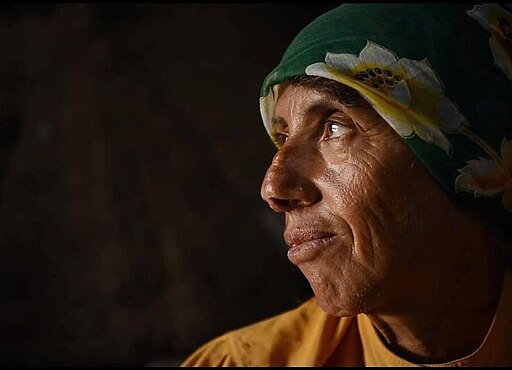
Portrait of Hatidže Muratova, the lead actress in Honeyland
In stark contrast to the aesthetically bright, even hopeful, tone of Honeyland is the current, dark reality in North Macedonia. On the night of 16 March 2025, a catastrophe occurred in the small town of Kočani when a fire broke out in a nightclub, in which at least 63 young people lost their lives. Almost 200 more were injured. After the catastrophe, the grief often mixed with anger and despair. In Štip, a university town not far from Kočani, schoolchildren and students gathered to commemorate the victims shortly after. One student held a sign that read: ‘Either we move away or we burn alive’. The sentence captured in a moment what many young people in the Balkans feel: a lack of perspective. I claim this lens allows a broader reading of what should be understood under ‘Demographic Anxieties’ than the usual fear of fertility decline in the context of rising nationalism.
Let’s for a moment say that ‘Demographic Anxieties’ is a catch-all term. What or who should be defined as the problems or issues causing this anxiety? For conservatives, the answer is usually grounded in the condemnation of a ‘progressive, valueless and rootless agenda’, influenced by individualised, family-alienated concepts of society, as well as multiculturalist approaches that include the increase of migration in their world view. Progressives might try to identify various forms of pronatalist policies as indicators of demographic policy that are more harmful than future-oriented, due to their ethno-nationalist character. When it comes to demographics, the Gretchen question remains asking: What needs to be analysed, so that it can be recognised as a problem and finally combated? Honeyland makes us reflect on this question through the eyes of the last wild beekeeper of her village, which is no more—trying to see the inevitability of demographic changes accompanying time, while at the same moment being confronted with the struggles it brings. That is the lesson of Honeyland.
Hatidže’s cyclical way of life, grounded and tied to nature, represents a disappearing reality in (not only) the Western world, which is increasingly driven by the logic of attention economics and different forms of economic exploitation. The arrival of the nomadic family, while initially hopeful, soon reveals the pressure of the present: their attempt to replicate Hatidže’s beekeeping fails as they bend to the demands of profit and overproduction. The consequences are the loss of their bees, their household, and eventually their decision to leave again. The message being that survival alone is not enough when embedded in unsustainable systems.
This is where the film mirrors today’s demographic tensions as well. Rural youth in the Balkans face a familiar choice: do they remain in environments that feel abandoned, or do they try to rebuild a life in urban centres elsewhere? Honeyland makes us feel the emotional and intergenerational dimensions of that decision. When the nomadic family moves on and Hatidže is left alone (even after her mother dies), another anxiety comes into view: loneliness—a loneliness not only of individuals, but of place. This is made especially clear in one outstanding scene. During a trip to Skopje’s Bit Pazar market, Hatidže tells a merchant: ‘There used to be more Albanians. We had 15 in the village. Apart from us, they are all in Turkey’. The exchange is casual, yet it reveals more than just Hatidze’s personal memory. It reminds us that demographic shifts are not just numbers, but ruptures in communities.
At the heart of Honeyland is Hatidže’s relationship with her bedridden mother. Their conversations provide an emotional backbone to the film and reveal how personal decisions are shaped by love, but also by a lack of alternatives. In one of the film’s most intimate moments, Hatidže asks her mother:
‘When the matchmakers came looking for brides, why didn’t you accept anyone’?
The mother answers:
‘I don’t know…’
‘For me, for me. When they asked for me’.
‘I was in agreement. I had given my consent’.
‘Who isn’t’?
‘Your father’.
Hatidže finally says:
‘Even if someone wanted me, I wouldn’t leave here’.
‘Why’?
‘That’s right’.
‘Don’t say that’.
‘Why’?
‘Don’t say that’.
‘What am I supposed to do? I can’t leave you behind’.
‘Of course you could.’ (long pause) ‘You could take me with you. The son-in-law would look after us. Ah my child… Blessed is he who cares. Ah my Hatidže…’
Today, the options of mobility are greater than ever. Between Skopje Airport and Germany, around 2,000 passengers travel back and forth every day. In the movie the aeroplanes remain distant objects of desire.
Across Southeast Europe, young people are facing a dilemma: they are torn between leaving their homes in search of opportunity and staying behind in increasingly unstable or neglected environments. Local struggles intersect with the promises of global mobility. The constant comparison of living standards via social media functions as a global stage for imagining elsewhere, while the socioeconomic reality is often shaped by corruption and institutional fragility. This uncertainty, on the one hand, strengthens the social foundations of belonging (the nation as a quasi-religious element that provides some sense of certainty about identity). On the other hand, young people are deeply engaged online and acutely aware of unequal living standards across Europe. Honeyland, set in rural Macedonia, echoes these dynamics and reveals their intergenerational continuity as well as the ruptures that accompany them.
[1] Lyric line from the well-known song Perspektiva by the Serbian band S.A.R.S.