Our Team at ENAS and NANAS Conference 2025
4th ENAS and NANAS Conference / 6th ENAS Conference
Ageing, Old Age, and Intergenerational Relationships through Narrative and Practice: Challenging Ageism
9 to 11 April 2025, University of Lleida, Spain
The panel “Histories that Matter: The Impact of Historical Legacies on Perceptions and Experiences of Aging,” convened and chaired by Dagmar Gramshammer-Hohl (University of Graz, Austria), brought together interdisciplinary research highlighting the enduring influence of historical legacies on aging experiences and perceptions across Eastern Europe and Central Asia. Team members Galina Goncharova, Saša Nedeljković, and Dagmar Gramshammer-Hohl presented their research and output from the Transforming Anxieties of Ageing project. They were joined by Botakoz Kassymbekova (University of Zurich, Switzerland) who gave a talk on post-Stalinist aging in Kazakhstan and Ukraine. Her presentation focused on how older generations in these former Soviet states coped with the lasting trauma of famine and repression, drawing attention to the narratives they constructed to make sense of their lives after decades of suffering.
Galina Goncharova (University of Sofia, Bulgaria) examined aging outside the family in post-socialist Bulgaria. She challenged the prevailing belief that old age has to be spent within the family unit, showing how EU social policy reforms, demographic shifts, and restructured care services have complicated and diversified older people’s experiences. Based on focus groups and biographical interviews with retirees and caregivers, her research illustrated how these changes are reshaping traditional values and producing new cultural models of aging.
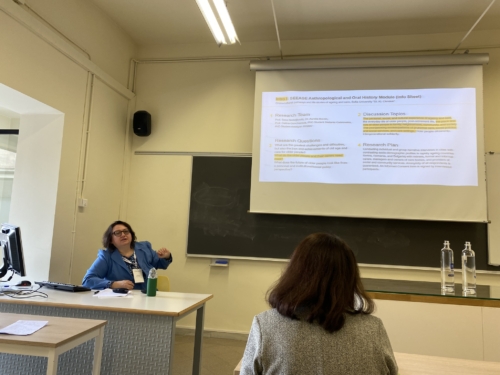
Galina Goncharova discusses changing aging policies and care structures in Bulgaria
Copyright: Ulla Kriebernegg
Saša Nedeljković (University of Belgrade, Serbia) presented findings from anthropological fieldwork conducted in three culturally distinct Serbian cities—Belgrade, Subotica, and Novi Pazar. His research showed how ethnic and regional histories shape divergent perceptions of aging, family care, and institutional support. The study highlighted the interplay between national and local identities, religion, and socio-political history in influencing aging experiences.
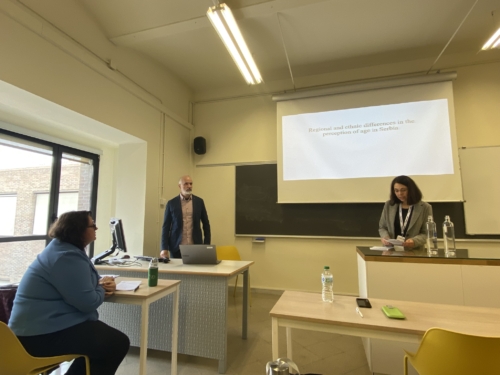
Saša Nedeljković presents findings from his fieldwork in Serbia
Copyright: Ulla Kriebernegg
Finally, Dagmar Gramshammer-Hohl addressed the theoretical framework of cultural aging. She emphasized the need for aging studies to move beyond Western-centric models by incorporating historical and regional specificities and putting the “periphery” on aging studies’ map. She argued for the examination of how different historical legacies matter in order to advance the theory of cultural aging.

Dagmar Gramshammer-Hohl calls for advancing the theory of cultural ageing through attention to historical legacies
Copyright: Ulla Kriebernegg
The panel offered insights into how collective memory, regional identity, and social change inform the lived realities of aging, challenging monolithic understandings and enriching the field’s global perspective.
The participation of our team members in the ENAS and NANAS Conference 2025 was co-funded by the Volkswagen Foundation as part of the project Transforming Anxieties of Ageing in Southeastern Europe.