Biram Hrvatsku: Managing (Re)Migration in Times of Demographic Anxiety
As Croatia confronts population loss, ageing, and regional decline, return migration has re-emerged as a powerful political promise. Biram Hrvatsku captures both the appeal of this promise and the doubts surrounding its demographic impact.
Croatia has long been confronted with a demographic dilemma. Demographer Ivo Nejašmić has warned that, without substantial change, the country’s population could regress to levels last seen a century ago. He frames population decline as an existential challenge rather than a routine policy problem. This language of urgency, which sometimes borders on the dramatic, encapsulates a broader sense of demographic anxiety that is increasingly shaping political debates in Croatia. Population decline, ageing, and regional imbalance are not sudden developments, but rather the cumulative result of long-term demographic, economic, and political processes. These include sustained emigration, uneven development, and labour market insecurity.
Against this backdrop, the Croatian government has repeatedly turned to migration policy as a tool of demographic management. With the launch of Biram Hrvatsku (“I choose Croatia”) in 2021, a return-migration programme administered by the Croatian Employment Service (Hrvatski zavod za zapošljavanje, HZZ), the promise of a policy response to demographic decline appeared to materialise. Framed as part of a broader set of labour mobility measures, the Biram Hrvatsku programme is comparatively generous by Croatian standards. It offers financial incentives of up to €27,000 to individuals willing to return from abroad or relocate internally to designated underdeveloped and depopulating regions. The programme’s official aim is to “strengthen economic activity in economically and demographically weakened areas” and to “encourage the return of an active working population”.
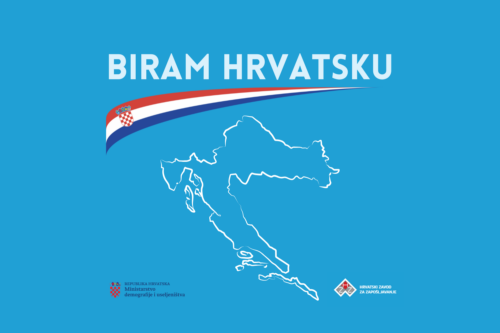
Nevertheless, despite the introduction of such measures, Croatia’s population continues to shrink and age, becoming increasingly imbalanced regionally. The government’s messaging, exemplified by the promotional Biram Hrvatsku poster featuring a map of Croatia and national colors, frames return migration as a patriotic choice. It is against this backdrop that the programme emerged, and it is these developments that have shaped how it has been interpreted, debated, and contested in public discourse.
Copyright © 2026 Ministarstvo demografije i useljeništva.
Biram Hrvatsku as a Policy Response to Depopulation and Demographic Governance
Biram Hrvatsku, launched in December 2021, is part of Croatia’s efforts to counter demographic decline and address regional disparities by offering targeted mobility incentives. The programme’s title carries symbolic weight, appealing to both national belonging and individual agency. It invites potential returnees and internal migrants to ‘choose’ Croatia over a continued life abroad or residence in more developed domestic regions.
The programme is institutionally embedded in Croatia’s labour market and demographic policy framework, and cannot be understood in isolation from the broader politicisation of demography in Croatia since the mid-2010s. Since then, demography has been elevated from a social policy concern to a central field of political intervention. Following a series of ministries related to migration and returns in the 1990s, demographic governance was gradually consolidated at the national level, culminating in the creation of a Ministry for Demography and Immigration in 2024. Earlier milestones included the establishment of the Council for Demographic Revitalisation in 2017, under the leadership of Prime Minister Andrej Plenković. This move signalled an attempt to centralise demographic coordination in response to deteriorating population statistics.
The adoption of Croatia’s first Demographic Revitalisation Strategy (2023–033) further entrenched demographic decline as a long-term governance issue, explicitly identifying return migration as a component of demographic recovery. In this context, Biram Hrvatsku has repeatedly been presented in official communications as an example of active demographic governance.
Unlike earlier diaspora appeals, which were primarily framed in terms of patriotic duty or cultural belonging, Biram Hrvatsku links participation directly to verifiable economic activity and measurable contributions to local labour markets. The initiative primarily targets the working-age population, with international returnees required to demonstrate at least twelve months of employment or education abroad within the two years preceding their application. Upon return, they must register as unemployed and engage in self-employment. By contrast, internal migrants are required to relocate from more developed to less developed counties while participating in self-employment support schemes. In both cases, participation is subject to strict conditions, including a mandatory twenty-four-month commitment and a legal obligation to repay funds in cases of non-compliance.
Numbers and Expectations
Data provided by the HZZ stated that by December 2025 a number of 1112 participants were active in the Biram Hrvatsku programme. According to data on 1,049 active participants provided to the author in mid-June 2025, most of the beneficiaries were international returnees, while internal migrants accounted for only a small proportion of cases. The age distribution of participants reflects the programme’s focus on economically active age groups, with the majority of beneficiaries being between thirty and forty-nine years of age. Geographically, returnees tended to settle in counties with stronger labour markets, such as Zagreb County, Osijek-Baranja, and Split-Dalmatia, rather than exclusively in the most depopulated or peripheral regions. Further analysis of sectoral data suggests that many beneficiaries found employment in construction, manufacturing and technical professions, with knowledge-intensive sectors playing a more limited role.
These figures contradict the implicit expectations associated with Biram Hrvatsku in political discourse. Return migrants are often seen as agents of demographic renewal, economic revitalisation and social change. In this sense, the programme operates as both a policy instrument and a carrier of demographic narratives that present return migration as a partial solution to population decline and ageing.
In the Media
Public debate around Biram Hrvatsku is most visible in the media, where the programme is consistently embedded in broader narratives of demographic crisis, census shocks and political responsibility. Rather than being treated as a technocratic labour market intervention, the media largely frames the measure as a response to alarming demographic indicators and as a test case for the state’s capacity to counter depopulation.
Between 2022 and 2025, Croatian newspapers and online portals repeatedly assessed Biram Hrvatsku in terms of its numerical adequacy. Headlines emphasised the difference between initial political announcements, which often promised several thousand returnees, and the comparatively small number of beneficiaries. Terms such as “fijasko” or “kap u moru” (‘a drop in the ocean’) were used to convey demographic insignificance.
A defining feature of this media discourse is the prominent role assigned to demographic experts. Journalists frequently consult demographers such as Anđelko Akrap and Stjepan Šterc in order to evaluate the programme’s effectiveness and contextualise its outcomes within broader population trends. Akrap, for instance, has been quoted dismissing the financial incentives as demographically negligible, arguing that one-time grants cannot meaningfully alter migration decisions shaped by structural factors. In these interventions, demographic expertise acts as a counterweight to government narratives. Expert voices are mobilised to emphasise demographic realities and question the logic of symbolic policy responses to structural decline.
Alongside this sceptical framing, media outlets also feature individual success stories of returnees who have set up businesses with the help of Biram Hrvatsku. These reports focus primarily on entrepreneurial returnees, presenting them as evidence that targeted incentives can facilitate reintegration at an individual level. However, even these positive cases are often accompanied by ambivalent commentary. Journalists tend to acknowledge individual success while simultaneously questioning its broader demographic significance, juxtaposing personal narratives with aggregate migration figures or expert assessments
Conclusion
Biram Hrvatsku cannot be understood as either a purely symbolic gesture or a comprehensive demographic solution. The programme combines a symbolic dimension with modest yet tangible support for those already considering returning, while being limited by the structural conditions that continue to drive emigration. In this sense, Biram Hrvatsku occupies an ambiguous position between symbolic politics and strategic policy intervention.
The establishment of diaspora ministries and associated organisations is often more about projecting an image of political commitment than producing immediate demographic effects. Biram Hrvatsku can be viewed similarly, as it reassures both domestic audiences and the diaspora that return migration is politically important, even though broader structural reforms remain limited. Public perception of the programme therefore highlights an enduring tension between political promises and demographic realities – a tension that continues to shape migration debates well beyond the Croatian case.
Bibliography
Bencze, E. L. (2020). Trends in demography and migration in Croatia. In P. Tálas & A. Etl (Eds.), Demography and migration in Central and Eastern Europe.
Hornstein Tomić, C., Kurilić, M., & Bagić, D. (2023). Croatia’s (Hidden) Potential: Highly skilled, young remigrants as agents of change.
Hornstein Tomić, C., & Pleše, B. (2013). Skilled mobility as a challenge for Croatian diaspora and migration policies.
Hrvatski zavod za zapošljavanje (HZZ) Mobilnost radne snage – Biram Hrvatsku (2024). In: Mjere aktivne politike zapošljavanja iz nadležnosti hrvatskoga zavoda za zapošljavanje: Uvjeti I načini korištenja sredstava za provođenje mjera u 2025. godini.
Hrvatski zavod za zapošljavanje (HZZ) (2025). Mjesečni statistički bilten, 12/2025.
Hrvatski zavod za zapošljavanje (HZZ) (2025). Correspondence from 18.06.2025 “Biram Hrvatsku – Analiza mjere (na dan 13.06.2025)”.
Nejašmić, I. (2011). Consequences of future demographic changes in Croatia. Acta Geographica Croatica, 38(1).